Basal Rosette Leaf Arrangement
Basic Botany for Foragers

Proper plant identification is crucial for safe foraging. Most plants cannot be identified by a single leaf. ‘Leaf arrangement’ must be taken into consideration. Botanically speaking, ‘leaf arrangement’ describes the leaves’ relationship to each other and the stem, shoot, or branch. Leaves can be opposite another leaf, alternate with other leaves, whorled or spiraled, or they can form a basal rosette.
‘Basal rosette’ describes the leaf arrangement when all the leaves appear to arise from the soil in or near the same spot, and the leaves extend themselves evenly around that central spot.
The word ‘basal’ originates from Latin and it means the base or bottom. Rosette is also from Latin. Botanically speaking, ‘rosette’ refers to ‘rose shaped’ structures made up of a number of petals or leaves. That definition has been stretched to describe the leaf arrangement of many plants, including the four wild edible plants described below.
I chose four different plants that look very different from each other, so that you can compare how the basal rosette leaf arrangement can be expressed in different ways with different leaf types and shapes. At the end of the article, after the plant introductions, you will also find more information on basal rosettes as a plant strategy. Yes, plants have strategies!
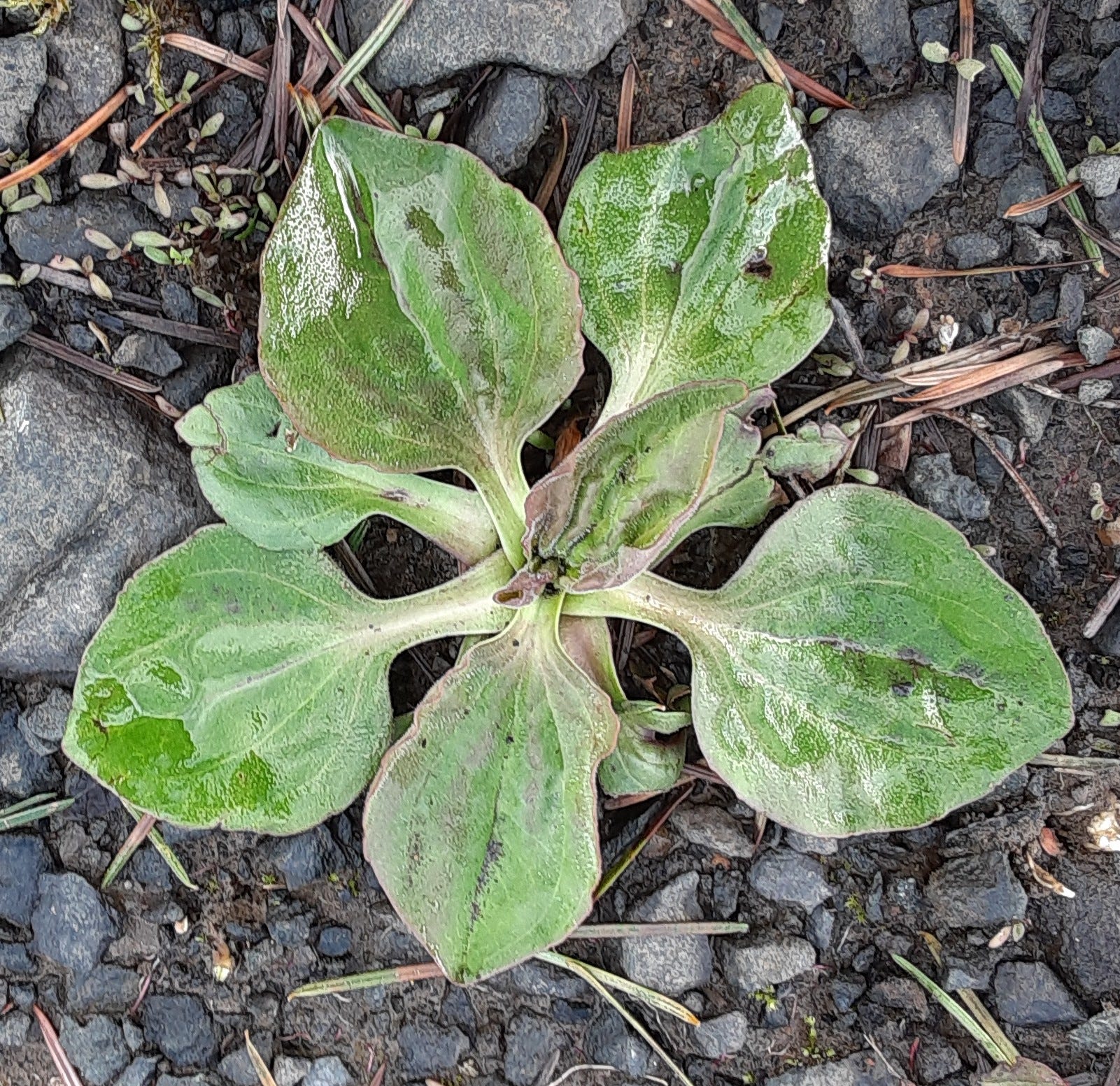
Broadleaf Plantain (Plantago major) was introduced to North America from Europe, and it is common in many urban and rural landscapes. The leaves and the seeds are edible and medicinal and non-toxic by all accounts I found. I have eaten the seeds and would do so again if necessity called for it. I learned to use the young tender leaves in salads, and the mature leaves in slow cooked soups and bean dishes, from my Gram, and I do enjoy them.
Meanwhile, Broadleaf Plantain is highly adaptable and variable, and it can sometimes be confused with potentially toxic plants. Be super careful of your identification before using this plant. It is always a good idea to have a book on the poisonous plants of your area, as well as one on weeds to help with your identification, and a copy of your state’s Flora on hand or available at your local library. With a good Flora, you can definitively dial in your identification for nearly every plant that occurs in your area. (See my article on The Power of Botanical Names for more info on Floras and identification.)
Broadleaf Plantain plants almost always spend their entire lives as basal rosettes. (I have noticed a very few specimens with leaves on their seed stalks.) But not all plants that start out as basal rosettes remain basal rosettes for their entire life. Some like, mullein and foxglove, remain basal rosettes through their first year of life, and then in their second year they grow tall straight leafy stalks that also produce flowers and seeds. However, it doesn’t always take a plant that is only temporarily a basal rosette a full year of growth before it starts producing leafy stalks.
Wild Cress (Cardamine hirsuta) pictured below in its basal rosette stage, starts producing leafy stalks within a few months and sometimes within a few weeks of germinating.
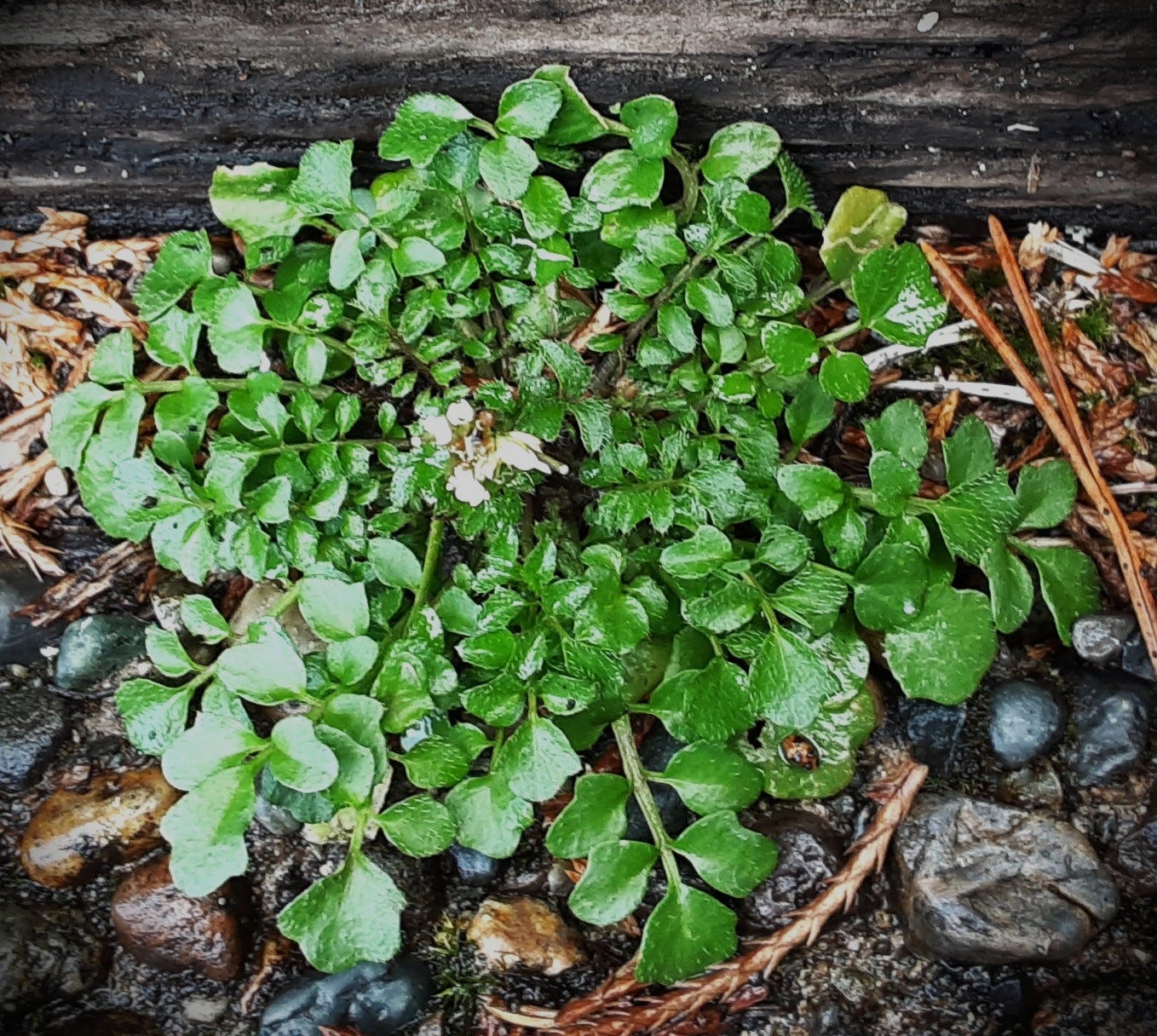
Wild Cress is a yummy late winter to early spring edible which you can learn more about in my article on Wild Cress. In that article, you will learn one of the names for this plant is ‘Hairy Cress,’ however, the plants are very rarely hairy. However, if you zoom in on this photo, you will see that this specimen lives up to the hairy common name. You will also find photos at the link, showing Wild Cress as it begins to form flowering stalks. By mid-spring the plants produce seed stalks, which you can see here. Once it has produced seed, it is at the end of its life for the year.
If you’re new to the study of botany, Wild Cress has ‘compound leaves,’ which you can learn more about here. And you can learn to tell the difference between leaves and leaflets (leaflets make up compound leaves) here.
Bitter Dock (Rumex obtusifolius) is another edible plant that starts its life as a basal rosette. In the photo below, we see a Bitter Dock plant that is a few years old, in late winter. It still has seed stalks with seeds that it produced last fall. The first seed stalks of its life arose directly from the basal rosette, without forming leafy stalks. But if you zoom in on the photo, you will see a new stalk is forming, complete with leaves.
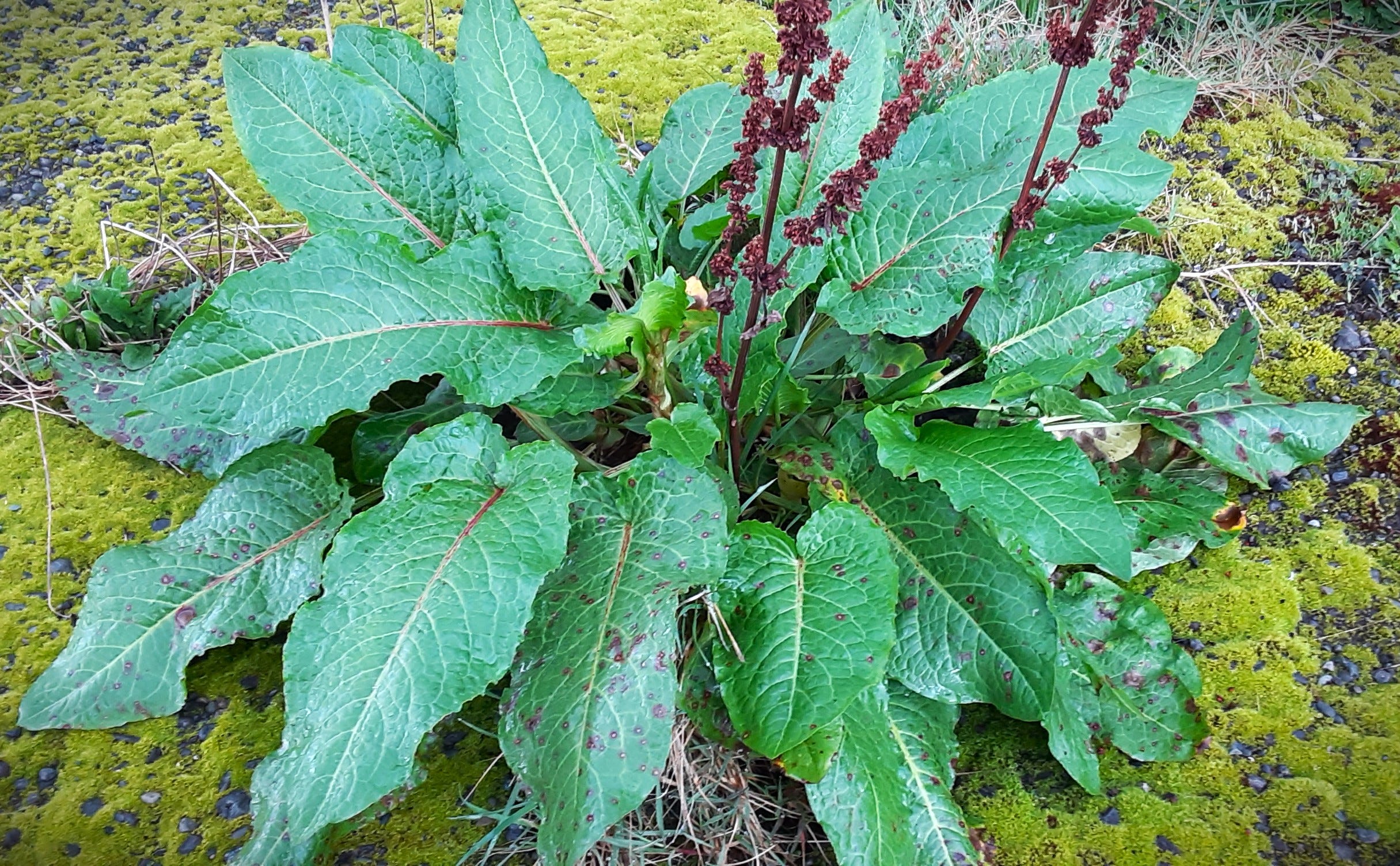
Bitter Dock. along with most other dock species, can live for many years. In winter or spring, depending on the climate, Bitter Dock plants produce a new flush of basal leaves and renew their basal rosette. Once the plants are mature, and they have stored enough energy in their roots, they will start producing leafy stalks with seed heads.
Bitter Dock is edible and medicinal with the same uses and precautions as Curly Dock, which you can read about here. Curly Dock, also known as Sour Dock, is quite sour. Bitter Dock isn’t quite as sour, and it does have some bitter notes in its flavor.
My Gram used to say, that a craving for sweet and mild tastes was a sign of immaturity, and that when one became mature, they would crave nutritious bitter foods. Just be very careful about your identifications and follow the precautions in the Curly Dock article before considering make any Docks part of your diet. For more discussion on this idea from another writer, check out, ‘On Food, A Near-Field Salad’ by John Gonter.
Buckhorn Plantain (Plantago coronopus) is our last plant for today. However, if you are a forager, naturalist, or botany enthusiast—I bet you can think of other plants that form basal rosettes, at least when they are young.
Pictured below, are two young specimens of this tiny plantain. The top plant is about an inch and a half across. I’ve zoomed in pretty close here. At this stage, no part of these little plants is more than a 1/4 inch off the soil.
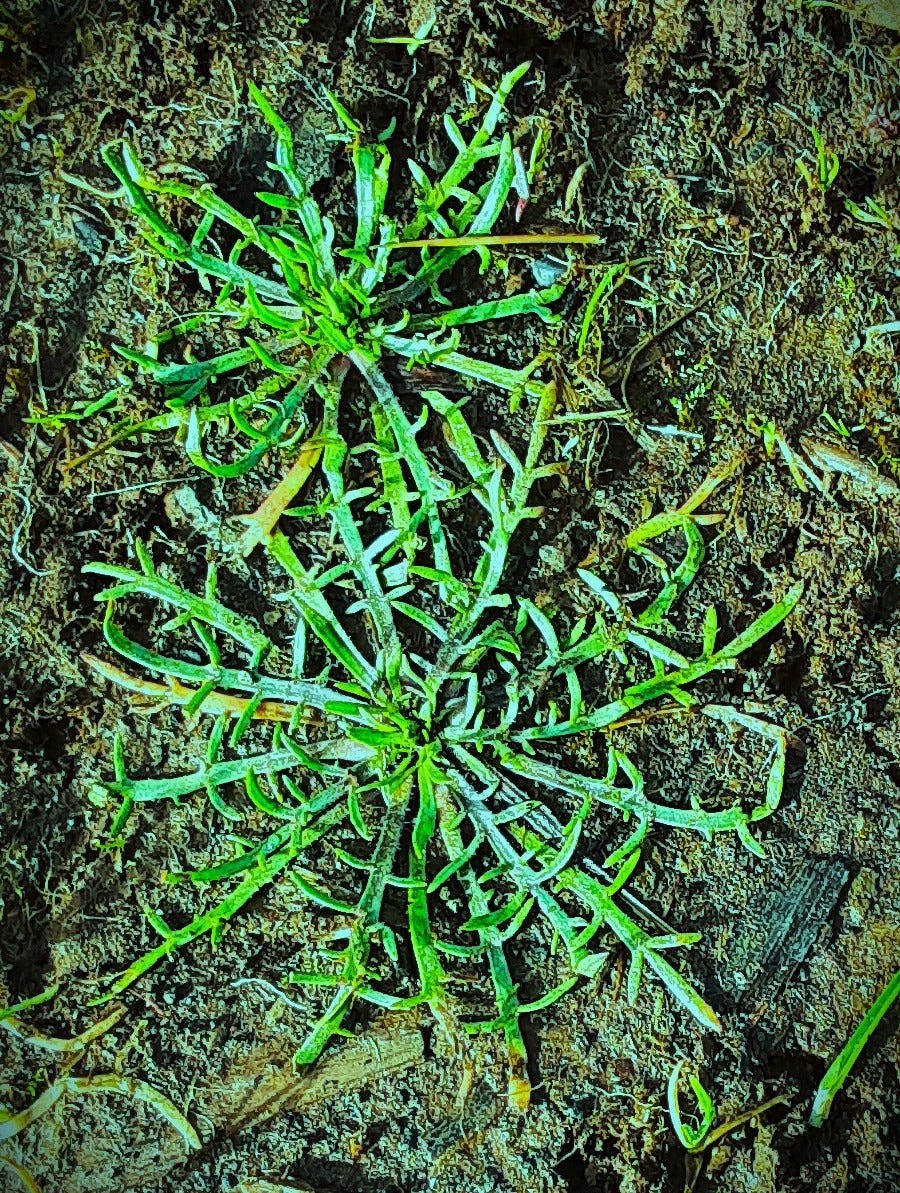
Buckhorn Plantain is also spelled, ‘buck's-horn plantain.’ It is a European native, where it is called Erba Stella for its star-like shape, and Minutina for its diminutive size. It is grown in Europe as a salad vegetable, and seeds are available in the US via mail order from a few outlets. The wild version is edible as well, but I haven’t tried it.
It is rare in my area, and I am always delighted to see it. At this young stage I occasionally see it growing right in the middle of sunny beaten down paths. The only adult plant I have seen, was barely off to the side of a seldom used side trail. Before I stumbled upon the adult plant, I had no idea that this was a plantain.
Plantains have very distinctive seed stalks, so that tipped me off. I went to the index of the ‘Flora of the Pacific Northwest’ (this book is also mentioned in my article on The Power of Botanical Names) and checked the index for ‘Plantago.’ Plantago is the ‘genus’ (the first part of the 2-part botanical name) that the herbal Plantains belong to. (But not the plantains in the banana family.)
“The Flora of the Pacific Northwest’ has every Plantago - Plantain known to occur in our region and there is nothing similar to Buckhorn Plantain, so identification was easy. It’s aways awesome to have the right tool for the job. More than likely, there is a Flora for your area as well.
Meanwhile, the only wild adult Buckhorn plantain I have ever seen in person, was very fuzzy. (The irregular color on the baby plants in the photo is caused by that fuzziness beginning to develop.) I don’t know about you, but I don’t like putting fuzzy leaves in my mouth.
However, the photos of the cultivated varieties look totally yummy and not fuzzy at all. If you like to garden, you might want to order some seeds, plant them, and let them go wild. They probably won’t revert to a fuzzy feral form for many years, if at all. I think they might be a big hit for fancy salads and garnishes.
Basal Rosettes as a Plant Strategy
Plants have strategies! These strategies have developed over the millennia as plants have adapted to the climates and landscapes where they have learned to thrive. Basal rosettes are a strategy that can offer plants a number of advantages.
Most seeds require some exposure to light for germination. Basal rosettes shade the soil directly adjacent to the plant. This reduces germination of other plants that might compete for space, the sunlight needed for photosynthesis, and for the moisture and nutrients in the soil.
Shading the soil also reduces soil heating and helps reduce soil moisture evaporation. This is a direct to plants with basal rosettes. It also benefits the soil microorganisms that form symbiotic relationships with plant roots, providing even more benefits to the plants.
The leaves that form basal rosettes have often developed strategies for collecting and directing rainwater, and some even condense water right out of the air on misty and foggy days. Even our little Buckhorn Plantain, as it grows and matures, does a good job of shading the soil under its leaves, and its fuzzy nature helps condense water on misty days and dewy mornings.
Everything in nature is for a reason. We just don’t always know that the reason is. We can, however, learn a lot by reading, observing, and asking questions. And that can help us better appreciate nature and forage safely. :)
~ ~ ~
Before You Forage
First and foremost, make sure your identification is 100% accurate, and always check a good book on the poisonous plants of your region to make sure you are not making a dreadful mistake.
Under ordinary, non-emergency situations, you need to know who has jurisdiction over the land you plan to visit. You need permission to forage on private property from the property owners, and you may need permits to forage on public land. Foraging is often prohibited in parks and on any land set aside for conservation. Avoid fines and possible criminal charges by knowing before you go. :)
Also, for your own safety, avoid any areas that have been treated with herbicide or pesticide, that are near roads and drainage ditches, or that may be exposed to runoff or emissions from commercial agriculture or industry of any kind.
~ ~ ~
This is the last article in the series on Basic Botany for Foragers, for now. I do recommend my article on ‘The Power of Botanical Names,’ linked below, to encourage your work in learning to identify plants. If in that process, you encounter botanical terms that don’t make sense to you, please feel free to leave a comment here (or on any of my posts or notes) And I will do my best to get some photos that illustrate the botanical term and write an easy-to-understand description.
Meanwhile, ‘The Power of Botanical Names’ is most likely behind a $5 paywall if you aren’t already a paid subscriber. That $5 will give you access to all of my articles for 3 + weeks. If you unsubscribe before the end of the fourth week you can avoid reoccurring charges.

~ ~ ~
Copyright, text & photos, Harvest McCampbell, 2025